Centenary Festival · Phase Two · Wednesday 1 July
The Unintended Consequences of Newton's Reductionism
Lessons from the Aquatic Sciences and the Need for Holism
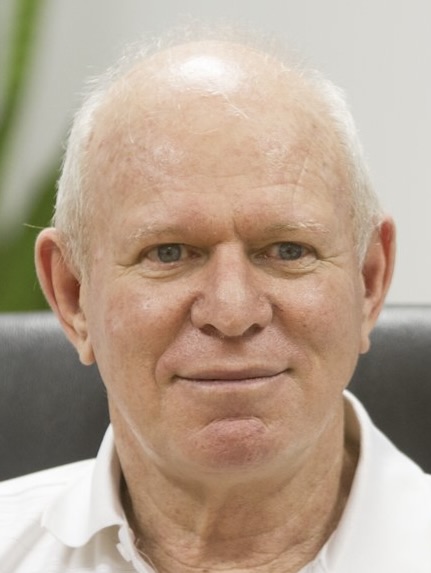
Dr Anthony Turton · Lessons From Aquatic Sciences
Dr Anthony Turton is former Unit Fellow at the South African Council for Scientific and Industrial Research and official spokesperson for the CSIR on water. He serves as a research associate Centre for Environmental Management, University of Free State and is Deputy Governor of the World Water Council where he is also editor for Africa of the Water Policy, official.
Watch the recording
Recorded Wednesday 1 July, 19h00 CEST. The full transcript is available below and as a downloadable PDF.
The full session
Read the transcript
Abstract
Dr Anthony Turton gives Phase Two its scientific foundation — not as a scholar of holism, which he is careful to say he is not, but as a working scientist whose whole career kept running into the walls that reductionism builds. The talk is structured as an intellectual autobiography: four lessons, drawn from a life that began around a campfire in the Kalahari and ran through combat service, the National Intelligence Service, a PhD in London, the CSIR, and a suspension that made him publicly visible.
The first lesson is that everything is interconnected, but the study of that whole is fragmented into disciplines — and that reaching across disciplinary boundaries is, reliably, a career-limiting move. The second is that physics and chemistry drive everything but cannot explain everything; he traces this through Descartes' masters and possessors of nature and the four rules of method that became his professional compass. The third is that geology has a fingerprint — the iridium anomaly at the K–Pg boundary, discovered by Luis and Walter Alvarez in the Scaglia Rossa limestone at Gubbio, and confirmed by the Chicxulub crater. The fourth follows from a chance conversation in a Stockholm taxi: radionuclide plumes measurable in European river sediments at one to two orders of magnitude above background, with a precise start date of 1945. We are living in a new geological epoch, the Anthropocene, while still applying Holocene reductionist dogma.
He grounds all of this in the aquatic sciences: the Murray–Darling Basin's irreversible salinisation, the Guadiana on the Iberian Peninsula with eighty dams and a saline wedge running 75 km up its estuary, and the Witwatersrand's 600 kilotons of uranium sitting in tailings beneath a million people. His central claim — offered to the Royal Swedish Academy of Sciences and met without a single hand raised in objection — is that water is a flux that flows in time and space, but we manage it as a stock. He closes with five aquatic risks that only holism and transdisciplinarity can mitigate, with the observation that the difference between can and should is wisdom, and with a rabbi's line he has carried for decades: a man can live months without food and days without water, but not a moment without hope.
A wide-ranging discussion follows with Christopher Cooke (El Niño and the limits of data), Prof Glen T. Martin (the Earth Constitution and the power of concentrated capital), Nnaemeka Prince Akano (Rotary's four-way test, Descartes, and whether we might speak of humanity's future with gratitude), Marc Pierson (the precautionary principle, and displacing greed rather than assaulting it), and Dr Elina Komarova-Tagar (what mining leaves behind, and how the Earth answers).
Transcript
Welcome and introduction — Claudius van Wyk
Claudius van Wyk: A great warm welcome to Dr Anthony Turton. A warm welcome, and with a deep sense of gratitude — not only for who you are and what you do, but for the fact that you were prepared to be awake at one o'clock in the morning, Australian time. Deeply appreciated.
Anthony, you are a former official spokesman on water for the Council for Scientific and Industrial Research — and that was an interesting story. You've been a research associate at the University of the Free State's Centre for Environmental Management. You are Deputy Governor of the World Water Council, and Africa editor for its journal, Water Policy. And in addition to all that, Tony, you are a multiple award-winning environmental activist.
Now, why that is so significant is because Phase Two of the Holism Festival project is where we look for where the rubber hits the road. We're looking for holism — holistic thinking — applied. And if anyone exemplifies that, you do. So it is with a deep sense of gratitude that I welcome all our participants here, and hand over to you, Tony.
The talk — Dr Anthony Turton
Dr Anthony Turton: Thank you very much. It's a great privilege indeed to address you on this topic.
I don't regard myself as an activist. It's almost a sensitivity that I have — an acute sensitivity — because I'm a person of science, a person of observation and understanding. I've had the unique privilege of being invited into an organisation some of you may or may not have heard of: Pugwash. Pugwash is a Nobel Prize-winning organisation, and it was founded by Joseph Rotblat — who is the man who invited me in. The significance of Joe Rotblat is that he was a nuclear physicist who worked on the Manhattan Project.
The Pugwash movement is something I hold very close to my heart, because it was based on the Russell–Einstein Manifesto. There's a long and lengthy manifesto, but in a nutshell, what resonated with me was this: good science should always have a moral conscience. And the other take-home message: just because you can do something — in that case, split the atom — doesn't mean to say that you should. Good science must always be aware of its consequences.
And if you apply that to the peer-review world: a lot of scientists are so sensitive about other people's opinions of their work. Well, good science should never be afraid of peer review, because good science should always welcome public scrutiny. So that's what I am. I'm a person of science — but I've never been comfortable being fitted into a particular silo. I'm a non-siloed person, and therefore, to some, I am considered a mongrel. Coming from Africa, I suppose I'm more of a hyena than I am a lion. But that's just what it is.
So what I'm going to do today is talk you through a summary of my personal journey, from early childhood to professional life, and ultimately to where I am today — a retiree, still with a lucid mind. I'm going to talk about the joy of moments of discovery. There have been moments in my life when I made a discovery, and discovery has always been an absolutely wonderful, exciting thing. Part of that was my discovery of Newtonian reductionism, and my even greater joy at discovering the work of René Descartes and his impact on Isaac Newton. I had the privilege, while doing my PhD work, of sitting under the famous apple tree at Cambridge, and I felt a sort of sense of presence there, for want of a better word.
Then, of course, there was my even greater joy at learning of a thing called the K–T boundary, which is part of sedimentary geology. You see, I jump around — I'm interested in biology and geology and botany and zoology and all of these things. And within that, my sheer fascination at learning that our generation is currently living through a geological transition of its own. There is a geological epoch unfolding right now, and I happen to be a proud member of this particular group of people.
I'm going to tell you a little about uranium — uranium isotopes as they apply to South Africa, but probably to other parts of the world too. And I'm going to close by saying that we are now living in a new geological epoch: the Anthropocene. I was born a Holocenean. But I'm now in the Anthropocene, and I gave a TED talk to this end. We should all be proud Anthropoceneans.
Where it all began — the Kalahari, and a name
So where did it all begin? I had a very unusual background, a very unusual childhood. My father was a Zulu-speaking white South African, and that was a curious artefact of history. My grandfather was left destitute after the Anglo-Boer War, and found himself a bywoner — a squatter, a tenant farmer, what you might call a kulak. Completely impecunious.
My grandmother was a remarkable woman, a descendant of German extraction, in fact of German royalty — but a very, very headstrong woman. She was in an advanced stage of pregnancy, and in the house they were living in there was no internal toilet, only an outhouse. She was feeling the effects of some peaches she'd been canning the day before, and unbeknownst to her, she was giving birth to my father. So my father was born in the outhouse, under those terribly sordid conditions, and my grandfather was horrified. Utterly horrified — that his son, carrying his own name, should be born in an outhouse in abject poverty. So he decided to do something about it. He migrated down to the only job he could find in those days, as a clerk of the court in Hlabisa, in Zululand — about as far removed from bureaucratic control by the British Empire as you can imagine.
So my father grew up immersed in Zulu culture as a small boy, learned to speak Zulu as a mother tongue, and was not very well educated — he was home-schooled, and never passed what we would call matric. So my father was not an educated man at all. But he went on to learn some skills, and one of them, besides speaking fluent Zulu, was that he knew how to shoot. He was the equivalent of Wild Bill Hickok and Annie Oakley in the American Wild West. He had the ability to shoot very accurately at a very long distance without aiming. He didn't have to close one eye and look down the barrel; he simply knew instinctively where his firearm was pointing. And so he could make a clean kill at great distance. He was a hunter.
And I therefore grew up, as a small boy, hunting with my father in the Kalahari. If anyone knows anything about the Kalahari — it's a great internal depression in southern Africa, an ancient inland lake, and it used to be the headwaters of some of the rivers that flowed out of it. Today it's a great, desiccated landscape, part of a huge desert, and water sometimes flows through there.
So as a small boy I found myself in this desert landscape, sitting around the campfire under those massive, massive heavens — the blue skies rent asunder by the magnificent Milky Way. The Milky Way was just absolutely exquisite. I would sit there with my face warm from the fire and my back to the cold outer wind, and in the distance you'd hear the hyenas laughing — that insane laughter — and you'd hear the lions roaring. I had an incredible sense of comfort. But looking up at the stars, I felt a sense of utter insignificance in the context of the universe.
I also had the privilege at that time of seeing the last of the great mass migrations — wildebeest, springbok, zebra, and elephant too. These animals would migrate vast distances. I was the last generation to see that. Within three years of that experience, Botswana became a sovereign independent state and cut a trade deal with what was then the European Economic Community. Part of that deal was that they would export beef to Europe, and the only way they could do that was to get certified free of foot-and-mouth disease — so they built fences. They built fences across those ancient migration routes. The first year of the fences was literally the last year of the mass migration.
Subsequently, I had the sad privilege of taking my son back there when he was a small boy, to look for those migrations. All we could find was a dead donkey at the side of the road, being eaten by a vulture. There were no more mass migrations.
And in that process I learned about my father's traditional Zulu name. His name referred to the reeds on the side of a river — the Phragmites reeds that grow along riverbanks. On top of the dancing leaves of those reeds, when the wind blows, a seed head suddenly pops up above them. That's what the name means. It refers to one who is part of a greater whole, but stands above. Stands above, but part of the greater whole.
I was just taken by that. As a small boy, watching the wildebeest and zebra and springbok, and sitting under that enormous night sky — in those days there weren't satellites up there yet, and there were lots of shooting stars — I felt utterly insignificant. But not irrelevant. And so I learned, from my father's name, the difference between significance and relevance. As a young child I grappled with that philosophical difference. And I came to the conclusion that I am as relevant as any one of those wildebeest or springbok, as relevant as any one of those millions of stars — but I am not irrelevant. My relevance is derived from being part of a greater whole. That has always been my founding philosophy.
I was gifted as a child with two things. One was a photographic memory. The other was an insatiable curiosity. If you know Rudyard Kipling's stories about the great grey-green greasy Limpopo, all set about with fever trees, where the Elephant's Child got its trunk through insatiable curiosity — I was that Elephant's Child. I learned how to observe, and with my photographic memory I stored all those observations away, in the hope that one day they might be useful.
I observed that water does, in fact, flow through deserts. Deserts are not sterile environments; they have very dynamic ecosystems, and a great deal is happening in them. We used to camp near the village of Gweta in the great Makgadikgadi depression, on the Boteti River. On occasion — maybe once every fifty years, maybe once every hundred — water overflows from the Okavango Delta and flows through that desert landscape. It's an episodic flow, and a great many things follow from it.
So I started observing. For example, that sodicity is linked to aridity. A sodic environment is one overloaded with sodium salt — a saline environment. And at the same time, because we used to draw our water at Gweta, where a well had been dug into the ground and we would lower ourselves down on a block and tackle — I observed that even in the driest environments, there is water underground. And more importantly, I observed that water is a social thing, because a vibrant village and a vibrant culture had grown up around that particular well, in an extremely remote part of a desert where very few people would ever venture, because they'd assume it was sterile.
I also observed that tectonics are a factor. The Okavango Delta, where I cut my teeth, is a tectonic location — the southernmost reach of the Great Rift Valley of Africa. As Africa tears itself apart, the southern tip of that rift lies buried beneath the sands south of the Delta. It's a fascinating place, because they're now finding water there, but they have to drill down four to six hundred metres to reach it, trapped in that tectonic feature beneath the desert sand.
Tectonics have also captured rivers. There is a fascinating thing in the Okavango called the Selinda Spillway, which links the Okavango to the Zambezi. Two great river basins, hydraulically linked — periodically, episodically, and in two directions. The river can flow either way depending on flood conditions. Most people believe that water flows downhill, and in this case it does — but because it's so flat, downhill can be this way or that way. I later came to learn that similar conditions exist in the Mekong. And later still I learned about the Chobe–Linyanti system, which is a very rich environment for wildlife.
As a young child I learned to walk long distances through the bush, because it was my job to fetch my father's Land Rover. I'd go walking with him while he was hunting, and then I'd have to go back and find the vehicle, wherever it was, and bring it back. If we dropped a buffalo, we might have walked for a day or two to get to it, and then my job was to walk back through the elephant and the buffalo, find the Land Rover, and bring it to where the animal had been shot.
And in the process I learned that everything is connected, but nothing is as it seems. I think that's an important message. And what we see today is not permanent. We like to think of everything around us as tangible and permanent, but actually it's all transient.
First lesson: everything is interconnected, but its study is fragmented
So my first big lesson — the first very, very big one — is that everything is interconnected, but the study of that whole is fragmented into disciplines. And woe betide the person who decides to reach out across disciplinary boundaries. Woe betide that person. It is a career-limiting move. That was a big lesson.
The physical sciences, as I subsequently learned, are based on reductionism and the empirical measurement of two variables — an independent and a dependent variable. If you can reduce complex reality to two things — temperature and pressure, distance and time, whatever — one comes first, you change it, and something happens somewhere else. My life has been a quest to find what those variables are, and which of them is independent and which dependent.
But then I also learned, because of the societies I was observing growing up around water sources, that the social sciences are based on an epistemology that defines the universe being studied and selects the methodologies needed. So it is not a neutral thing. When you work within the framework of a paradigm, the paradigm tells you how to define the problem and how to select the solution to that problem. Both are relevant, but each is exclusive of the other, and very few reach across from one to the other.
And there I had my first aha moment. I fell in love with the study of epistemology — which is probably boring, boring, boring to most people. But epistemology is the science of determining truth: how knowledge is constructed. Is the knowledge of the traditional San, who have lived in the desert for tens of thousands of years, relevant in a modern world where Newtonian physics defines how the Doppler effect works, how the mobile device in your hand works?
That was the aha moment. My one critique today, working with PhD candidates, is that very few of them understand epistemology. And one of the greatest stumbling blocks I find with would-be PhDs is that they can't separate an independent from a dependent variable. I have to spoon-feed them to help them grasp the concept.
Second lesson: physics and chemistry drive everything, but can't explain everything
My second big lesson — another aha moment. Physics and chemistry drive everything, but can't explain everything.
Physics is generally about gravity, and we need look no further than what's happening in the world now to realise gravity can be lethal. Gravity is powerful. It's what keeps us all firmly rooted to the chairs we're sitting in. And gravity is generally your friend — until it isn't.
Newtonian reductionism is the gold standard, but Cartesian logic explains why. And here I go back to my PhD time in London, working under Professor Tony Allan, my mentor and my guru. I loved every moment I spent in his presence.
I was staying in a hall for foreign graduate students at the Goodenough Trust in Mecklenburgh Square, London, and there I met a young Canadian woman who was a philosopher. I had never met a real-life philosopher. I'd always felt philosophical leanings, but I'd never met a genuine, touchable, you-are-a-philosopher person in my life — and yet I was studying for a PhD, a Doctor of Philosophy. I thought I'd better learn a little about philosophy if I was going to carry that in my title.
She said: you need to understand René Descartes. So I dutifully went and started learning about Descartes. And one of his famous lines — nous rendre comme maîtres et possesseurs de la nature — by observing, we can render ourselves masters and possessors of nature. She said: that's what you need to understand. And I was taken by his powerful descriptions: knowing the force and the actions of fire, water, air, the stars and heavens, all the things I'd intuitively grown up with, and all the other bodies that surround us — and thus rendering ourselves masters and possessors of nature.
And that flew in my face. Because my childhood experience was not as a master and owner of nature; it was as an observer and participant in nature. This master-and-ownership thing was a very important part of growing up in apartheid South Africa, where the whole issue of racial tension and master-subservient relationships was very much part of the lived experience.
So this became one of the most exciting moments of my life. Through that Canadian philosophy student I learned about Descartes' Discourse on the Method. I then discovered the links with Francis Bacon, and how these combined to shape what became the Scientific Revolution that Isaac Newton was part of. And I subsequently met another woman, an American from upstate New York, who was part of a team working for Shell — she was developing, with the famous Frenchman Pierre Wack, the methodology of scenario planning, for which Shell became world-famous. So I got sucked into scenario planning on the sideline as well.
In London, I discovered the same joy I'd experienced under the night sky of the Kalahari, contemplating the fact that I'm insignificant but not irrelevant. The Discourse on the Method details Descartes' quest for absolute certainty by doubting all prior beliefs and establishing the existence of the self — famously summarised as I think, therefore I am. And the one thing I've always been is a thinker. I've probably overthought things. My mother used to tell me: just lighten up a bit, stop thinking so much. Think less and be happy — because a thinking person is very often not bubbling with effervescent enthusiasm.
From that moment I adopted Descartes' four rules of method. And later in life, when I was invited to become a Rotarian, I discovered that they are remarkably similar to the Rotary four-way test. The four rules are:
- Accept only the self-evident. Never accept anything as true unless it is known clearly and distinctly to be true. Avoid precipitate conclusions and preconceptions, accepting only what presents itself to the mind so clearly that it is beyond all doubt.
- Break down difficulties through analysis. Divide each problem into as many constituent parts as possible, and resolve each of them more easily.
- Think in an orderly fashion. Conduct thoughts in systematic progression, beginning with the simplest and most easily understood objects, gradually ascending step by step to the most complex knowledge.
- Be thorough, and review. Make complete enumerations and general reviews to ensure nothing is left out and no logical step is missed.
Those four things are pretty much the framework by which I live my professional life. I had lived it before that, but from that moment it took on a more tangible, coherent whole.
Chemistry is logical, because it's simply about anions and cations. Opposites attract, likes repel. If you understand that simple thing and apply it to chemistry, you can make predictions about how things will react.
But this left me excited and frustrated. I've always had that tension in me — being incredibly inquisitive and excited by my inquisitiveness, but frustrated that it doesn't explain everything I want to understand. I wanted to connect things. I needed to understand how holism matters. But I was hampered by institutional career pathing, and by dogma.
Dogma, and a country at war with itself
I use the word dogma deliberately, because I subsequently came across a great deal of it.
Because I was the product of a country at war with itself, I was conscripted, and I served twelve years in the army on the front line of combat operations. I was later moved across to the National Intelligence Service, where I played a significant role in establishing the democracy we now live under.
There I learned that dogma can be your undoing. Dogma is almost like a prison sentence — like a pair of handcuffs you can't break out of. I saw dogma as the enemy to be vanquished. But I never knew how. I instinctively knew that to take dogma head-on would be fatal. If you're driving down a road in Arkansas and a blue light pops up behind you and asks you to pull over, don't resist — to resist is fatal. They have the power of the state in their hands. To resist is futile. I did once get pulled over driving up to Baltimore, and I was fully compliant, and the officer went to the computer on his dashboard and confirmed exactly when I'd entered the country and what visa I held. I was amazed, in the 1980s, at how he knew everything about my life just by looking at a screen in his cruiser.
So I learned a skill of adaptation, and of hiding my true inner feelings. I never wore my emotions on my sleeve. I'd hide away my inquisitiveness and simply adapt to the reality — but I always felt uncomfortable within that dogmatic environment. In the South African context, the whole idea that if we have a strong army, we will prevail — I knew, as a front-line combat soldier, that the strength of our army meant diddly-squat when you're facing tens of thousands of angry people burning tyres who want liberation. The strength of your army is actually a disadvantage at that point. And that's what took me into the National Intelligence Service, working with Dr Niël Barnard and creating the pathway to the negotiated transition we had.
Third lesson: geology has a fingerprint
That leads me to the third big lesson: geology has a fingerprint.
One of the many fingerprints is the K–T boundary — the boundary between the Cretaceous and Tertiary periods. It's now formally called the K–Pg boundary, because fashions come and go, but it defines the same thing. It was discovered by a team led by the Nobel Prize-winning physicist Luis Alvarez and his son, the geologist Walter Alvarez, along with the chemists Frank Asaro and Helen Michel.
This is interesting in its own right, because of where it happened. While studying a distinct layer of marine limestone in the Scaglia Rossa Formation near Gubbio in Italy, Walter Alvarez discovered a mysterious thin band of red clay that cleanly separated the Cretaceous from the Tertiary. A thin clay-like line, literally etched into the rock.
He then discovered the fossil shift. Immediately below the clay line, the rock was filled with a massive variety of foraminifera — tiny marine fossils. Above the clay line, the rock contained none of them. Something had happened, associated with the presence of that line — a massive and abrupt mass extinction.
And the third discovery was the iridium anomaly. To determine how long the clay layer had taken to form, Walter asked his father Luis to measure its composition. Using highly precise nuclear chemistry, the team found the clay contained up to 160 times more of the rare metal iridium than the surrounding rock. The significance of iridium is that it is so rare on Earth that it is associated with meteor impacts. So there you have a layer embedded in rock at 160 times background — two orders of magnitude.
This was later confirmed by the discovery of the Chicxulub impact crater in the Yucatán Peninsula, which forms part of the Gulf of Mexico. And at that point in time I was truly blown away.
I'll tell you a story. I was working a lot on transboundary rivers and found myself invited to an institution in Central America. I was flying from Atlanta down to Costa Rica, and a lovely young woman was sitting next to me, fluttering her eyelashes, with a fellow beside her who looked like what I'd describe as a gridiron jock. She started talking to me, and who am I to resist being spoken to? So I said: look out of the window — because we were flying over part of the Yucatán, and as far as the eye could see there was a string of volcanoes. Look at those. There's a volcano, and in a straight line, another, and another. This is a volcanically active area. Isn't this just amazing?
And we had this intense conversation, and this jock-like fellow suddenly got aggressive, clenched his hand into a fist, pointed a finger at me and said: I know what you are. You are a goddamned creationist! So I said, okay, no — I believe in dinosaur mass extinctions. He's actually the creationist. I'm the one challenging his thinking, because I'm a scientist putting evidence in the way of his simple view of the world. Anyway, that was just a little story on the side.
Mining, and the externalisation of cost
At that point in time I was working at the CSIR in South Africa. The war had come and gone, and I was in my post-war environment, working as a scientist.
An opportunity came up. I was part of the World Summit on Sustainable Development, which was hosted in South Africa. South Africa is a mining-based economy, and a thing was created called the Mining, Minerals and Sustainable Development team — the MMSD. Their job was to show the world how wonderful mining was, how healthy it was for the environment, and how progressive South Africa was.
So they made me part of that team, and I applied my mind. We studied the impact of mining — which, of course, is massive. And because we'd just come out of the armed struggle, and because the USSR had just imploded, we studied a great deal in the former USSR, particularly uranium and lignite mining. And we found, to our very great surprise, that in all cases the externalisation of costs was justified for national security reasons.
We then developed an economic model. I had the privilege of drawing all the squiggles on the graph — I like drawing these horrendograms, because I'm a simple-minded person, and the only way I can understand a complex reality is to draw a few lines on a page and see how things connect. So I drew a set of graphs: this is what happens to the value of the extracted minerals over time, this is what happens to your environmental liability, this is what happens to the externalised social cost. And we eventually published it as an externalisation of cost model.
And it showed, shock and horror, the following. (a) Mining is needed for economic and social development. (b) Existing business models all externalise the environmental cost, taking it off balance sheet. So mining, in and of itself, is not a sustainable enterprise.
Now, this flew in the face of what they were trying to achieve. They were trying to show the world how wonderful and progressive they were, and here was Turton saying: no, you can justify it by various means, but you can't justify it in terms of sustainability.
That got me thinking about how we make mining sustainable, and I went down a rabbit hole. It was very interesting where that rabbit hole took me, because I became seriously involved in developing the thinking around sustainable mining. Everything we have — the computers we're looking at, the microchips, the semiconductors that let us communicate across twelve time zones as we're doing right now — all of it comes from mining. So I'm not anti-mining at all. I'm inquisitive about how we can lessen the impact of mining, and how we can mine more sensibly.
Going back to Russell–Einstein: just because we can split the atom doesn't mean we should — and just because we can dig a hole two kilometres into the Earth, can't we do it a little bit smarter? Can't we do it in a way that leaves slightly less of an impact? Can't we align it with the long-term interests of the local villages that may be negatively affected?
So I learned that if full-cost recovery were attempted, most mining operations would not be bankable. And this discovery was not popular at all.
The Tooth Fairy Project
I was observing that in South Africa, for every ton of gold pulled out of the ground, between 10 and 100 tons of uranium was pulled out with it. And uranium, until 1945, had no commercial value — so it was discarded as waste.
While I was in America I learned of a project that got my inquisitive mind going: the St Louis Baby Tooth Survey, the longest-running longitudinal human health impact study in modern history. Because America was detonating nuclear devices in the 1940s and after, a dentist in St Louis, Missouri asked: what is the impact of radionuclide fallout on children? And he came up with the very clever idea of harvesting milk teeth from young children — getting the tooth fairy, so to speak, somewhere to send those teeth. They went to the school of dentistry at the university, and from a large sample they could determine the impact of radiation on calcium formation in the tooth. They now have that data over eight decades — longitudinal data that tells them exactly what happened to those people over time, correlated back to radionuclide contamination in the calcium of their bones.
Turton has never been one to have delusions of grandeur, but he has never been afraid of being inquisitive. I thought: if they can do it in St Louis, why can't we do it in South Africa? So I proposed the Tooth Fairy Project — to harvest milk teeth and determine whether humans were being affected by the uranium in the many, many mine dumps around the Johannesburg–Witwatersrand mining area. The concept was actually introduced to me by Pugwash, believe it or not.
My Tooth Fairy Project was announced in the media. And it became a career-limiting move. From that moment my career took a downhill trajectory, because I was now bumping head-on into the mining industry, and they didn't want anything done on uranium impact. They wanted nothing. If you talked about uranium, they used to refer to Mineral X. Mineral X — you can't even use the word. The word itself is that sensitive.
Fourth lesson: a new geological epoch
My fourth big lesson: we are now living through a change in geological time that is not yet formally called an epoch, but may well become one.
Getting back to my work at the CSIR on mining, five things rapidly became evident:
- Uranium had no commercial value before 1945, so it was merely discarded as waste.
- The Witwatersrand gold mining basin, with Johannesburg at its centre, is the most uranium-contaminated urban landscape in Africa — possibly in the world.
- Human migration has now placed around a million people in direct contact with uranium-contaminated tailings in Johannesburg.
And now, as a scientist with access to the equipment, I could go and measure things.
If anyone has ever had any contact with Johannesburg — when I was a child, the flagstones and paving at the side of the streets were laid on yellow, golden mine-tailings sand. The uranium-contaminated tailings are everywhere in Johannesburg. Everywhere. It was in the void under the raised wooden floors of the better-quality houses, because tailings kept the termites and insects away. And no one ever asked: why are the insects dying? The insects are dying because of radon gas emitted as uranium decays — and radon is heavier than air, and its human health risk is now well studied all over the world.
So, getting back to my earlier statement that good science should have a human conscience: it was, for me, unconscionable that so many people could be exposed to this. And as a scientist who knew about it and failed to act, I would have been a co-conspirator to something almost like a crime against humanity. I could not be part of that. So the activist in me — even though I don't like the word — obliged me to speak out.
Then we started measuring. And we found that the bricks used to build houses are made of clay very often associated with the close presence of mine tailings — and therefore bricks carry a high level of radionuclide contamination. So now the question becomes: almost every older house in Johannesburg has been built out of those bricks. Do we announce that people are living in direct contact with uranium? What are the implications? Do you cause a mass panic? How do we deal with this from a professional and a moral-ethical perspective?
As the CSIR's spokesperson on water, I was the media's first point of contact for anything water-related. I had the media at my disposal; I could have made a statement, and they would have listened. But I didn't make a statement on the uranium contamination, because of the fear of what the consequences would be.
And then we began to learn that uranium plumes are now measurable in river sediments at one or two orders of magnitude higher than the iridium found at the K–T boundary. There, iridium was the signature. Here, in our rivers in South Africa, we have radionuclide contamination at least one to two orders of magnitude above background — uranium and its derivatives, and not only uranium: nickel, lead, cadmium, a whole host of heavy metals.
Political leadership and big corporations don't want to know about this problem. So to work in this field is literally a career-limiting move. The Tooth Fairy Project had consequences, and my consequence was that I was eventually suspended from my role at the CSIR. And it was that suspension that propelled me into a fairly high level of public visibility, because the media got wind of it — what's happening, why is he being suspended? — and it turned into an utter fiasco. But I won't go down that rabbit hole.
So I was confronted by an ethical dilemma: do I shut up and protect myself, or do I act according to the Russell–Einstein Manifesto that I believe in as a Pugwashite? And I chose the latter. I chose it unashamedly, and I have absolutely no regrets.
Stockholm, and the date 1945
And then I found myself at a very interesting moment in my career. Out of the blue, I received an invitation to the Royal Swedish Academy of Sciences in Stockholm.
The pretext was that Malin Falkenmark — a professor I had a close association with, and who had been directly involved in the first World Summit on Sustainable Development — was being given a lifetime achievement award. She was the only person with the presence of mind to ask a simple question: is there a finite limit to the number of people that a given unit of water can sustain? She did her PhD work trying to quantify that number — what later became known as the hydraulic density of population. Part of her prize was that she could invite eight or so people from anywhere in the world who had used her work and taken it to the next level. I was one of those eight.
So I found myself in a taxi from the hotel to the Royal Swedish Academy of Sciences. And being the inquisitive person I am, I always talk to the person next to me. He was French-speaking, and I speak rudimentary French, and I asked what he did. He was also there for the Falkenmark ceremony — and he was working on radionuclide plumes in river sediments. That immediately piqued my interest. He was a geochemist.
And he told me that radionuclide plumes at one or two orders of magnitude above background are measurable in European rivers. Now, that's surprising. They haven't been detonating nuclear devices in Europe. So what is going on?
I told him about my CSIR work on mining, and then I asked him: is there a date, like the K–T boundary at roughly 65 million years before present? He looked at me without batting an eyelid and said: yes. 1945.
The first detonation of nuclear weapons. So 1945 is precise. They now use it as a sedimentary marker in the rivers of Europe: anything older than 1945 has no radionuclides; anything younger does.
And in that moment I knew my life had come full circle. It was literally an aha moment. A bingo moment. I became part of the team with Malin Falkenmark and Michel Meybeck and a number of others, and we published a paper in 2014: The Unfolding Water Drama in the Anthropocene — Towards a Resilience-Based Perspective on Water for Global Sustainability, in Ecohydrology.
I laboured under the illusion that we were the first people to publish about water in the Anthropocene. But I did a good old Google search and found that we were not. The first was Paul Crutzen, the man who developed the term Anthropocene, who published in 2002 on aquatic ecosystems, and how scientists had begun linking human alterations of the global hydrological cycle to large-scale universal changes. So Crutzen was the first to write about it, but we were in the second group — and I'm very proud of that humble achievement.
I was then asked to present my work in Granada, Spain, at the Association for the Sciences of Limnology and Oceanography. I'm not an oceanographer, and I'm not a limnologist — but I know what they do, and I've rubbed shoulders with a lot of them. So I was quite humbled to be invited, and I gave a plenary talk there on transdisciplinarity, in which I referenced the uranium plumes in South African rivers.
The four lessons, restated
So let's start tying this together. What were the four lessons I've learned?
One. Everything is interconnected, but nothing can be understood holistically, because of Newtonian reductionism and dogma. Newtonian physics is actually a limiting factor. Those who believe so doggedly that this is it — the supreme thing, the ultimate — are wrong, they are wrong, they are wrong.
And I stuck my neck out at the Royal Swedish Academy of Sciences, surrounded by incredibly well-educated people. I said: I'm going to make a statement now, and I want you to tell me, by a show of hands, if you disagree with me. And the statement was this:
Water is a flux that flows in time and space. But we manage it as a stock — a single-use item.
And not one person put up their hand to refute it. So I said I'd take that as democratic affirmation. And from that moment I've talked to anyone who'll listen about water as a flux managed as a stock. Therein lies the secret of our future, because the volume of water on planet Earth today is the same as it was when the dinosaurs roamed freely. When you cleaned your teeth this morning, at least one molecule of that water went through a dinosaur's kidney at the time of the K–T boundary. And in all likelihood another molecule went through someone else's kidney a week or so ago. That's the reality of life.
So the good news is that we're not going to run out of water; technology will help us through. The bad news is that water quality is getting to be nasty.
Two. Physics and chemistry drive everything, but can't explain everything.
Three. Geology has a fingerprint — and in fact water also has a fingerprint. You can fingerprint water with a high level of precision and know exactly where it comes from. That's what enables salmon to swim up rivers and spawn in the place they were born: they know the fingerprint of the water. They have sensors that read the anions and cations — the sodium, the calcium, the bicarbonates — and they know exactly where those lead back to.
Four. We are now living in a new geological era, the Anthropocene, but we are still applying Holocene dogma. We haven't broken free from reductionism, and if anything that dogma is being reinforced. We see attempts to stifle science, to defund it, to take funding from major institutions because they are not politically expedient. So we're going backwards, not forwards.
The proof: aquatic ecosystems under stress
Where's the proof of what I'm saying? We need look no further than aquatic ecosystems, because they contain a lot of the evidence.
Aquatic ecosystems are an interface — between land and water, the great biblical divide noted in Genesis, where the creation story is first the water, then the land, then all the living things. They are the interface between surface and atmosphere. Between saltwater and freshwater. Each of these has a fundamentally different physical and chemical signature. And they are the interface with global-level forces that drive ocean currents and the hydrological cycle.
The ocean currents of the world are driven, to a large extent, by the flows of one river out of South America, which alters the salinity of the southern Atlantic. As a result you get thermohaline circulation, which becomes the Gulf Stream, which causes New York not to freeze over as Moscow does.
The Murray–Darling Basin. I now live in Australia, and I'm learning about Australia. The Murray–Darling is an incredible hotspot — a hotbed of intense political positioning and bargaining. An arid but vast landscape with a very sparse human population. The alteration of the flood pulse by the Snowy Mountains hydroelectric scheme is the immediate cause of all the problems. It has altered the flows of water through arid areas where high evapotranspiration occurs, and one of the unintended but entirely predictable consequences is irreversible salinisation. Remember what I said about sodicity being associated with aridity: here you have a very arid environment, and you are depositing salts on the land which then evaporate off it. Salinisation is an inevitable, predictable outcome.
Estuarine flows have been so fundamentally altered that a saline wedge intrusion is now a reality, and people at the distal end of the river are fighting against it — but it too is predictable and almost irreversible.
Science is not popular there, because it clashes with political realities on the ground. People want their river, their irrigated agriculture, their jobs. They don't want to hear science saying: if you continue doing it this way, you're going to end up with a sodic landscape, and nothing will grow here. It will become like the Makgadikgadi salt depression. They don't want to hear that.
There's another thing I've observed: new order rights. Rights accrued by people given irrigation entitlements after the commencement of the project. You can't simply take those rights away now, so you get a clash of legal entities, with people defending their rights. Law and policy have lagged behind development, so they are reactive only. And sustainability is a swear word in a highly politicised debate that presents science as the villain.
The Guadiana. Recently I was invited by people associated with the Australian Foreign Ministry to sit in on a diplomatic meeting with visitors from Portugal, who wanted to learn about salinity and river management in highly arid areas. The subject was the Guadiana River on the Iberian Peninsula — a large transboundary river in the southern part of Spain and Portugal, with a big dam they are very proud of, the Alqueva, one of the largest reservoirs in Europe.
The basin is shared between Spain and Portugal. They have eighty dams in it. Eight-zero. So the flood pulse is completely destroyed — feeble or non-existent. And the storage is eight times the mean annual runoff. By comparison, the Orange and Limpopo basins that I know in southern Africa are at 2.7 times.
The Albufeira Convention was signed in 1998, giving Portugal rights and allocations. The area drained receives 550 mm of rainfall per annum — very, very low, a Mediterranean environment with hot dry summers and cool rainy winters, and 80% of the rain falling in winter. The Guadiana forms part of the border between Spain and Portugal, and there is a saline wedge that runs 75 kilometres up the estuary. And that wedge will go as far inland as gravity allows it to go. It is an unstoppable force.
Environmental NGOs are concerned about hypersaline waters in the estuarine salt marshes, and there is groundwater depletion in the upper reaches in Spain that has become a major problem — the groundwater has been completely depleted. Once it's gone, it's gone. The same thing is happening in the Levant, in the Middle East, in North Africa, and in the Ogallala Aquifer of the United States.
And here's the physics: the demand for ecological releases will not mitigate the saline intrusion. If you release fresh water from a dam upstream of a saline wedge, the saline water — being denser — sinks to the bottom, and the fresh water flows over the top. You will empty your dam, the water will flow over the wedge, and it will not make the slightest difference to the average salinity of the estuary. You will waste your entire reserve. And that's it.
The Witwatersrand. For every ton of gold removed, between 10 and 100 tons of uranium was removed, mostly discarded as waste. Migration has created a situation where more than a million people now live on uranium-contaminated tailings disposal facilities.
The total uranium load in the Witwatersrand mining basin is 600 kilotons, quantified with the highest level of precision, across the hydraulically defined mining basins of the area. It is concentrated in the western basin, where 400 kilotons sit in just three mine dumps.
Uranium and other heavy-metal plumes are now measurable at orders of magnitude above background — exactly like the K–T boundary — in river sediments and in wetlands, typically associated with the upper reaches of the basin.
And then there are the aeolian plumes: wind-blown plumes of fine dust that have never been measured. Dust blowing off these mine dumps could be deposited hundreds, maybe thousands, of kilometres away. We know sand from the Sahara gets blown across the Atlantic. No one has ever measured ours, because it's politically inexpedient and the mining companies do not want it to happen. So we do not know to what extent we are depositing this alien form of uranium pollution over our food-producing areas.
We also found, measuring the radioactivity of building materials, that the concrete used was very often made from waste rock contaminated with uranium. So there are buildings whose concrete structure itself carries a measurably high radioactive signature. And there's that moral-ethical thing again.
Rainwater acidification. Sulphur dioxide and carbon dioxide both alter the pH of rainwater. It's extremely hard to measure, because if you measure a drop of rain as it falls and then measure the pH half an hour later, it will have changed — the gases have outgassed. It's the presence of those CO₂, SOₓ and NOₓ compounds that alters the pH.
This interacts with the soil to bind or release micro-elements. And it is the low pH of rain that releases uranium from the tops of your tailings dumps. Anything below pH 5 — and we measured rain at pH 3, which is almost battery acid. That low-pH rain falls on the flat tops of the mine dumps and concentrates uranium. Through each wet-and-dry desiccation cycle the uranium is mobilised and concentrated in the crust. Then, in the hot dry months, the wind blows and carries that fine dust away over vast distances. We're seeing that happening now across our agricultural land in South Africa.
Ocean acidification. The top ten metres of all oceans are the most biologically active, and the top two metres are where active gas exchange occurs. The oceans have a larger surface area than the landmass, so they are terribly important for gas exchange, particularly sequestering carbon — and it all happens in the top two metres. Saltwater chemistry is generally alkaline, so carbon is sequestered into corals and shells. Acidification alters this fundamentally: you can't get seashells forming, you can't get coral reefs forming, and therefore you're not getting permanent sequestration of carbon.
Four observations
At no time have we ever had access to as much information as we have today. At no time in our collective history has trust in human scientific information been so low. At no time has the need to think holistically been so high. And at no time has our capacity to reach consensus been so low.
At the very time when we are able to harness the sum total of human knowledge as never before, we also have the lowest capacity to convert that knowledge into viable policy in our collective best interest as a species.
Just because we can do something — like splitting the atom, or fracking the Earth — doesn't mean we should. And the difference between can and should is wisdom. Wisdom is a scarce commodity.
Five aquatic risks that only holism can mitigate
There are five aquatic ecosystem risks that now show themselves at global scale, and that only holism and transdisciplinarity can mitigate:
- Salinisation — taking place all over the world.
- Eutrophication — look no further than the reflecting pond in Washington, DC. Nutrient enrichment causing biological life to flourish, particularly blue-green algae, which is toxic. Blue-green algae are the oldest life forms on the planet; they gave us the oxygen we breathe.
- Acidification — of soils, of oceans, of rain.
- Endocrine disruption — a very serious one, and we don't know how to deal with it. Look at schoolchildren today: a great many have food intolerances, attention and concentration disorders. It's all to do with endocrine disruption. We've thrown endocrine disruptors into the environment; they're in the water we drink and the food we eat.
- Persistent organic pollutants (POPs) — things that persist for long periods in our aquatic ecosystems.
Closing
In closing: I've shared my journey through life with you, in the hope that you might learn something from this humble journey of mine. I've shared four lessons.
One: everything is interconnected, but nothing can be understood holistically because of Newtonian reductionism and dogma. Two: physics and chemistry drive everything but can't explain everything. Three: geology and water both have fingerprints. Four: we are living in a new geological era, the Anthropocene, but we are still applying Holocene reductionist thinking.
We need to understand the limitations of Newtonian reductionism, and actively build a community that embraces transdisciplinarity as an asset rather than a threat. If we get this right, we might be able to survive the transition from the Holocene to the Anthropocene. Because, you see, the last transition — the K–T transition — was a mass extinction event. Let's not lose sight of that.
Hominids have only been around a relatively short period of time. If you look at hominid species, the longest-living has been around for four million years — and every single hominid species besides ourselves has become extinct. So we already know that hominids end up extinct; Homo sapiens is no exception. At least, if we think holistically, we might have a fighting chance. I don't want to be pessimistic, but we might have a fighting chance.
Above all, I've tried to demonstrate that while I, as an individual, am utterly insignificant — my relevance is derived from being part of a greater whole. You are all part of that greater whole. Holism, for me, has been a living journey rather than an ideological quest.
And with that, I thank you for your time and attention.
Questions and discussion
Claudius van Wyk: Wow. Tony, that was a bit mind-blowing. A deep challenge.
Just a few observations. What struck me was your point about relevance versus significance. What also struck me was the deep implication of your insight that water is flux, it's flow, and we treat it as stock. And when you said that the molecules of water I'm drinking might have passed through the kidneys of a dinosaur — where we live here at a thousand metres in the Sierra Nevada, we get our water from melting snow. I don't mind that it went through a dinosaur's kidney; I just hope there's no uranium in it.
But I think the most significant message is that we need that paradigm-shifting consciousness. And that is what the Holos Earth Project is about — to create that community.
One observation while we wait for hands. Our last presentation was by Dr Glen Martin, who was talking about the need for exactly what you described: a global Earth Constitution. He's on the call with us today.
Christopher Cooke — El Niño, and the limits of data
Christopher Cooke: So, Anthony, I've learned I need to flutter my eyelashes at you when I ask this. It's a question I was posed in the field today by the owner of a large land base. He just popped up with it, and I didn't quite know how to respond, other than to say he needed to reach out to those with better knowledge than me. Given your wizardry with the core dynamic of the soul of water — the soul of life on this planet — what do you think we need to prepare for with the next significant El Niño event? There's a lot of news about it at the moment, and the pending chaos likely to arise. It's a hydrological issue, and arguably the scale of event you're interested in.
Dr Anthony Turton: Before I answer — I'm interested in your accent. Where are you from?
Christopher Cooke: I'm currently in Cornwall, but I'm from Northern England. And I've really revelled in your talk. I've had a long, hot day, and your presentation was so refreshing I feel like I've had a shower. So thank you.
Dr Anthony Turton: You almost had a bit of a Geordie accent there — not quite Geordie, but nonetheless.
So, El Niño. It is a very real phenomenon. It's not an airy-fairy thing sucked out of the thumb of some smart scientist who wants a peer-reviewed paper so he can get a bonus at the end of the year. It's not that at all.
Southern Africa, where I grew up, is not dissimilar to Australia, where I now live, and both find themselves boxed in between three major forces. One is the El Niño Southern Oscillation — a planetary force, because, shock and horror, I've learned that the Pacific Ocean does actually exist, and that it covers almost half the planet. I drove along the east coast of Australia a couple of months ago and was shocked at the vastness of it.
So what happens over there bounces around. In the case of Africa it comes through via the Indian Ocean Dipole, which bounces the signal down into the Indian Ocean. And then at the opposite end you have the Great Southern Ocean, which sends huge, cold fronts up onto the southern tips of all the continents. In other words, we are bounded by these massive forces. And I find it bizarre that people would even question their relevance.
When I was doing my PhD in London I was quite shocked to find that parts of south-east England are, in fact, fairly arid — if you apply the hydrological definition of aridity. So we grow up with these illusions. As I said earlier, there's an illusion of permanence, but actually everything is very transient.
The bottom line is that these things are all interconnected, and all indications are that El Niño will become an increasingly important global phenomenon. We see it playing out in different river basins now — the Guadiana in Portugal and Spain, and the Murray–Darling, which tends to have a millennial drought once a century. Those droughts are really big, and I think we're heading for another one in the not-too-distant future. All indications from current data are that this event is quite an extreme one.
I'll close by saying that we are privileged to live in the modern world, and also cursed to live in it. The privilege is that we can see all the data — all those satellites telling us exactly what's happening. For the first time we can have a truly global view of phenomena. And yet at the very same time we are meeting resistance from politically defined narratives that reject science, that reject knowledge. I think this is an enormously dangerous time in our evolution as a species.
Christopher Cooke: I don't think there is a perfect answer, but I really appreciate your response. It reminds me of something else you said, because I totally agree: we've got the data, but while the interpretation of that data runs through models and constructs dominated by a reductionist or Newtonian perspective, there's always a phase lag before we get anywhere near the answer.
I also wonder if there's a slight contradiction between the need for more holistic awareness and the call for transdisciplinary science. I think we need to be very clear in our language. We're looking for words that describe a science which is the wholism of the primary knowledge and wisdom our species holds.
Dr Anthony Turton: Where the social scientists play a role is, firstly, that their logic is fundamentally different from the natural sciences. They are driven by an epistemology in which they define what it is they are studying, and that has implications. But where they can play a role is in helping the hard sciences to communicate their findings to a political audience — because ultimately it all becomes politicised. And that's where the purple hits the fan.
Let me share one other observation. Mathematically, when you start integrating more than three variables, you don't get one definitive outcome — you start getting an envelope of probabilities. The general Joe Soap in the street hasn't got a clue about that. People don't understand that stochasticity is a reality. Stochastic events are real.
And if we are trying to model global climatic systems, you've got more than three variables — hundreds, maybe thousands. So the fact that we cannot predict one precise outcome with a high level of accuracy doesn't mean the science is bad. It means that's the scientific process. Those are mathematical realities, and we need to communicate that well.
I got a lot of experience in that as the media spokesperson for water, because water is highly contested in South Africa. I learned a lot about positioning a message and getting it across — not always successfully, but it's a learning curve. The important thing is that mathematics is one of the limiting factors, and we need to educate people. Social science can do that. But unfortunately social scientists tend to use big words that often don't mean too much — all fluffed up, words that sound sexy but actually aren't.
Prof Glen T. Martin — the Earth Constitution, and the power of capital
Prof Glen T. Martin: Thank you very much for your presentation. It was truly astonishing, and even though I'm not a scientist, I agree with all of your conclusions.
For many years I've been working to ratify the Constitution for the Federation of Earth. The authors of that Constitution — hundreds of people, environmentalists as well as legal thinkers — wrote it during the last several decades of the 20th century precisely to give the people of Earth, the common good of the people of Earth, the authority to implement the kind of things you're talking about that might just save us as a species.
In 2021 I published a book called The Earth Constitution Solution: Design for a Living Planet. In it I studied and reported on the major environmental thinkers, and almost across the board they agree with your basic premises: there is a critique of Newtonian thinking and the classical Cartesian model, a need for holistic thinking, and a need for humanity to unite under the principles we understand through science, which you might say is our one common language worldwide.
But several of those authors pointed out and detailed the power of capital, the power of money. You mentioned the political controversies — here in the United States, which are very true — but they are driven in many instances by money. The big oil companies have routinely discredited science and been behind the effort to get people to doubt the computer generation of probabilities. There is an active effort by huge concentrations of wealth worldwide to prevent human beings from uniting together.
So, to make this into a short question: at the last session of the Provisional World Parliament, we reactivated the Earth Emergency Rescue Administration, whose current chair lives in Spain. It is trying to bring together people and thinkers and scientists and activists into a force. Ultimately that force wants to ratify the Earth Constitution, but it also needs to network with people worldwide. I'm wondering whether we could call on you as a consultant — whether we could talk with you on occasion when we're formulating policies and procedures.
Dr Anthony Turton: I would welcome that. As I said earlier, my relevance is derived from being part of a greater whole. So while I've still got a functioning brain — even if my memory lapses sometimes — I've still got a sharp brain, and if I can make a difference, that is my purpose for being on Earth. I will gladly do anything you ask of me. It's only a pleasure.
Nnaemeka Prince Akano — the four-way test, Descartes, and gratitude
Nnaemeka Prince Akano: Anthony, I'm grateful for the insights you shared. I learned a lot — one of which is that the difference between can and should is wisdom, and of course wisdom is a scarce resource.
Something you and I share is membership of Rotary International. I happen to be a Rotaractor and a Paul Harris Fellow, and I can genuinely attest that the four-way test of the things we think, say or do can be applied widely across every area of social endeavour, even in the family. It has been one of my ethical and moral compasses. I ask myself, even as I speak now: Is it the truth? That's the first. Is it fair to all concerned? — which encouraged me to yield a second time so that others could speak. Will it be beneficial to all concerned? And will it build goodwill and better friendships? Each time I recount that four-way test it's been a genuine joy walking down that path.
The second thing I have in common with you is your affinity for René Descartes. I'm something of a Descartes scholar myself — this is my copy of Meditations on First Philosophy and Other Metaphysical Writings.
Above all, I'm curious about how we talk about humanity's presence on Earth and the future for us as a species. How do you think we should be speaking of humanity's future? From the place of what we can and what we should do — or could we also incorporate gratitude for living on Earth and existing as a species, even if it means we eventually become extinct like the dinosaurs?
Dr Anthony Turton: Well, we're getting into normative discourse now, and normative discourse is not an area I know too much about. It's very often the place of religion, of belief systems. I think we must understand that there are belief systems out there, and we must be respectful of them. The big challenge is how we harness them.
In terms of the Earth Constitution, one way forward might be to look at faith-based communities. They exist everywhere in the world, they already have massive constituencies, and they are an interface between the normative value you're trying to create — a better future for humanity — and an existing grassroots constituency. It becomes a political process, and not an easy one. But the bottom line is that people have belief systems.
Let me give you an example. I mentioned growing up in the Kalahari; I also grew up on its fringes, around a place called Pandamatenga in Botswana. It's thick, dense bush — you can't see fifty metres ahead of you — filled with elephant, buffalo, leopard and lion. A dangerous place. And as a twelve-year-old, my father would think nothing of sending me to walk for six hours to bring back the Land Rover. On my way I'd encounter lion, elephant, buffalo. All dangerous animals.
And I learned humbleness from them. The humbleness was that I would always ask for permission to move through their territory. I would never walk in silence; I'd walk making a noise. And if I came to a water hole, I knew there would always be lion there — and lions are lazy creatures, not worried about eating me, but they don't want to be surprised. So as I approached the water I would clap my hands and sing a praise song to the lions, praising them, telling them I recognised that this was their terrain, and asking permission to pass through. And in all cases they allowed me to pass safely. I never once had a bad encounter.
Would I tell my grandchildren to do it? Probably not — it might be considered reckless now. But that's how I grew up.
So: respecting other communities, and more importantly realising that animals also have conscious systems, and that animals communicate. They have social hierarchies, norms and values. Look at how elephants communicate over vast distances using infrasound, and compare that to how whales navigate the oceans — it's exactly the same. From my house in KwaZulu-Natal I used to overlook a bay where female whales came to give birth. I've witnessed the birthing of calves, and the whole process of a calf being socialised into the pod, and I've seen exactly the same behaviour in elephant herds. Exactly the same.
So we must stop being arrogant as human beings and thinking that we alone know everything. Homo sapiens is the name we've given ourselves — wise man. Actually, we're not that wise.
And the message for humanity at the moment is quite a bleak one. Because if we continue on the track we're on, we are likely to enter a self-imposed mass extinction event. The essence of the Anthropocene is that human beings are the only biological being imprinting on the geology of the Earth. We are changing the geological structure of the Earth, and this has profound implications — and I don't think we've even begun to ponder what that means.
Marc Pierson (via chat) — should we be suspicious of intervention?
Claudius van Wyk: Tony, there's an observation in the chat from Marc Pierson: isn't an implication of your talk that we should be suspicious of any intervention in ecology and geology?
Dr Anthony Turton: The simple answer is no — not suspicious, but cautious. The precautionary principle is an important principle in any environmental management, and it tells us that there will always be an unintended consequence; until we know exactly what that consequence is, we ought to default to the side of caution.
I'll give one example. Consider the way we register chemicals for use. There's a complicated protocol that differs from country to country, but you register one chemical, and you have to understand what that one chemical does. Nowhere has anyone figured out what happens when a thousand different chemicals come together in a cocktail in the ocean. What new molecules are being formed? We don't yet have the regulatory framework even to begin to comprehend that.
And the reality is that because our population has outstripped our natural hydrological supply, we're producing a huge quantity of wastewater. I would almost describe sewage management as a global crisis. It's collapsed in South Africa — completely collapsed. But I had the privilege, when I was in the World Water Council, of being invited to Washington, DC by a very senior man who chaired the interagency task team on water. He took me on a kayak trip along the Potomac and described the complicated sewage management problems they have on that river — the one flowing past the reflecting pond they're now drawing water from for the monument. It's a highly eutrophic system, a highly altered system.
That taught me it's not just a developing-world problem. It's a global problem. And the developed world is very often a victim of its own arrogance. He made a statement that American engineers had been so smart they designed wastewater works to treat even the runoff coming off the roads — they wanted to clean the water to such an extent that all road contaminants would be processed. But now all those systems are overloaded, they can no longer function properly, and they can no longer raise the capital to upgrade.
So I said to him: if a spacecraft were hovering over the Capitol, sending a message take me to your leader — are you telling me that at the centre of global power, where that spacecraft is hovering, that country is unable to manage its sewage? And he said: yes, you are correct.
It's a global crisis. And we're putting chemicals into the waste stream that were unthought of. Just look at what's happened since the 1960s, since birth control medication was invented — the amount of oestrogen going into wastewater and coming back into the system. It isn't eradicated; it's metabolised and altered. These are really serious matters. We need to have a serious think about the implications.
Dr Elina Komarova-Tagar — what is left behind
Dr Elina Komarova-Tagar: Good evening, and thank you very much, Anthony — also for speaking about your childhood and your family. I felt very proud to be in South Africa, resonating with what you were talking about.
I've been living in Africa for more than twenty years, and I'd like to ask about what stays behind. In the 21st century we have more and more sophisticated technology, and it becomes more efficient — you extract everything, you leave nothing there. But what is happening with the iron ore, with all those by-products? Because suddenly it transpired through your presentation that it is uranium contamination as a counterpart of gold mining.
So if we look at the Earth's mining process — what is left behind in different regions? We benefit from taking, but we are ultimately changing that geological structure. And suddenly we become small, and more penetrable. So how will the Earth react — and can we map that reaction?
Dr Anthony Turton: That's a great question. Let me try to answer it as succinctly as I can.
Firstly, you need to understand that the geological ore bodies we are mining were typically laid down in a period of geological time that was oxygen-deprived. Oxygen is a fairly recent phenomenon on this planet. A lot of the gold-bearing ore bodies are heavy metals, and heavy metals tend to be found in alluvial structures — structures shaped by water, in riverbeds or at the bottoms of lakes, where heavy metals concentrate. Think of the films you've seen about gold miners in the Klondike or Alaska, developing a sluice: they run the aggregate across a sluicing bed, and the heavy metals fall out. That's exactly what happened in the lakes and rivers of the world before there was oxygen on the planet.
That's the important thing, because associated with those ore bodies — because they were oxygen-deprived — is an iron-sulphur compound. Sulphur and iron combine in the absence of oxygen to form pyrite. So a lot of your heavy metal bodies are pyritic, and so is coal. Remember the coal-mining belts you mine today are the early ferns and vegetation that grew in a carbon-rich environment when there still wasn't atmospheric oxygen — indeed, they produced the oxygen we breathe today. All of these things were laid down in a generally oxygen-deprived geological period. That's the first thing.
The second thing is that when you expose pyrite to oxygen, the sulphur oxidises and becomes sulphate. Sulphate combines with water and oxygen to create sulphuric acid. So you get an environment in which acidification takes place under natural conditions — and it's almost like a fire that produces its own oxygen. Once it starts, you can't kill it, because it feeds itself. Those acidification processes are very profound, and they have profound implications for the consequences of mining.
Now the next thing. Just because we can put a man in space and bring him back safely — and we've done that many times — I remain, inherently, an optimistic person. We know mining is generally destructive. You cannot dig a hole in the ground and not destroy 100% of what you're digging; the space you dig is 100% destroyed, you can't destroy it less than 100%. But surely we can do it in a more responsible way.
And in that regard I believe — naively, perhaps — in the sapiens part of Homo sapiens. The wisdom part. Surely we can realign mining. I gave a TED talk about realigning mining with that wisdom. If we can move vast cubic kilometres of earth just to unlock a mineral, can't we place and deposit that material in such a way that we do something useful with it?
In one very large open-pit coal mining operation in South Africa — the pit would be something like 24 kilometres long in its final form, effectively an acid-producing lake — I proposed that, just through the placement of the waste, we might engineer an aquifer. Could we engineer the waste in such a way that it becomes useful after the life of the mine? The technical answer is yes, it can be done. But you lack the will for it. You can even justify it economically, if you quantify the social licence to mine correctly. Maybe it costs a little bit more to place the spoil in a certain position — but it can be done.
So we get down to a basic human condition, and that's called greed. If we're greedy, and we want to maximise profits for a minimum number of people, that is simply not sustainable. So I keep coming back to that normative argument: I believe we can do things differently, I believe we should do things differently, and I'm frustrated because I don't yet know how. But that's where I am in my journey. We can land a man on the moon and bring him back safely. So we can dig a hole in the ground and make it sustainable — we just don't want to. That's the nut we've got to crack. And I think holism has at least got a fighting chance. A fighting chance at survival.
And just in conclusion: when you communicate these things, there is psychology involved. If you communicate a negative message, people tend to shut down. If you tell people that mining is ugly and unsustainable, they don't want to hear it. They just don't care; they switch off. So you've got to position that message in a positive way. That's the challenge of the communicator. The art and the science of communication becomes critically important in this context.
Marc Pierson — displacing greed
Marc Pierson: This is very quick. It is my settled opinion that trying to deal with greed, and with a lot of negative approaches to social situations, is a fool's errand. The only chance we have — and this is not a naive, idealistic chance, it's a very grounded one — is for people to work together to create things locally that work. To think you can directly assault greed is ridiculous. You can only displace it. The only way to get rid of greed is for the population to become more and more pro-social. I'm not saying people shouldn't try to stop greed — but if you don't simultaneously create more generosity, actual practical generosity where people work together to do things, greed will win.
Dr Anthony Turton: Yes, I agree with you. That's a statement more than a question, and I completely concur.
Marc Pierson: I loved your talk, by the way. I love having a scientist show up with a bunch of holists — my view of holism couldn't have been better articulated than by your talk. So thank you so much.
Smuts, Botha, and the bittereinders
Dr Anthony Turton: When Claudius invited me I was quite terrified, because I told him: I'm not a scholar of holism. I've never studied it. My connection to holism was actually through Smuts — and through my great-uncle. My great-uncle was Louis Botha.
Louis Botha and Smuts were both soldiers in the Boer War. They were both bittereinders, and they both went on to become quite prominent people. In fact — I'll reach over here — this is an artillery shell. Can you see it? That comes from Botha's battery, over the siege of Ladysmith.
The significance of both these men is that they were profound thinkers who came out of the Boer War, and they had both undertaken to fight to the bitter end. And yet they both reached the realisation, in their lives, that to fight to the bitter end means you end up with a scorched earth and a lose-lose outcome.
In my own professional life as an intelligence operator, I had taken an oath to fight to the bitter end. So I'm a bittereinder, like Smuts and like Botha. And I also had to make that very hard decision: if we fight to the bitter end, we're going to end up with scorched earth. That's how I became involved in creating the enabling environment for constitutional reform that brought about democracy in South Africa. I am inherently, intrinsically a constitutionalist. I believe in constitutionalism.
A final word — not a moment without hope
Claudius van Wyk: Anthony, I think it's about three o'clock in the morning where you are. Thank you so much for sharing your wisdom, your insight, your research, your knowledge — the graphic description of the hugeness of the existential challenges we face, and yet holding the candle of hope that if we mobilise ourselves around holistic principles, even in our own local areas as Marc was suggesting, then there is hope, and then we can influence a new Earth, as Glen was saying.
We've got a variety of topics following through this year, looking at what the practical implications are. But yours has established the kind of groundwork Glen was talking about — why we need this deep, collaborative international effort. We'll be looking at artificial intelligence, at food production, at human habitat, at all of those things. Thank you so much for your contribution.
Dr Anthony Turton: May I close with a short statement?
I had the privilege, in part of my career, of working with Mikhail Gorbachev. I met him personally, met his family, and met some of his advisers. One of his advisers was a rabbi, and we had coffee together in a Starbucks in Kyoto, believe it or not. He was a survivor of the Holocaust. He had been left on the front doorstep of a family in Amsterdam — much like the Anne Frank story — with a family called Soetendorp. I asked him his name. He said Awraham Soetendorp, and I said, that's funny — that's not a Jewish-sounding name. And he told me that when he was living with the Soetendorp family, they brought him up as a Soetendorp, as a Christian, but they brought him up never to forget that he is, in fact, a Jew.
And then he told me something, and this is my closing statement. He said that in his experience:
A man can live for months without food, and days without water — but not for a moment without hope.
That's the powerful concluding statement I'd like to make. Our role here is to bring about hope. Because the survival of the human spirit requires hope. That is the nuclear power of this engine of sustainability: hope. Thank you.
Vote of thanks — Joshua (JP) Malkin
Joshua (JP) Malkin: I'd just like to thank you, Anthony, for sharing your life journey, for sharing your intellectual and scientific wisdom, and for giving us hope for the future. You and Glen and so many others exemplify the deep ethos of the Holos Earth Project. What we're hoping to do is to link so many people together, so many networks together, to try to create a hopeful future in the face of the polycrisis you've described so graphically. Thank you so much again — I personally appreciate your wisdom, and I hope that you and Glen can connect, and that you can share your wisdom with the Earth Constitution network.
Claudius van Wyk: Thank you so much. Thank you for being up in the middle of the night, and thank you to those who have stayed the distance. Our next presentation will look at the critical issue of our food systems — against the context that has been described, and how that can be done in a different kind of way. Thank you, everybody. Stay in touch.
© 2026 Claudius van Wyk. All rights reserved.